
How to Size an Autoclave Chamber for a Hospital CSSD
The correct autoclave chamber size is determined by daily sterilisation demand, load composition, cycle time and the required turnaround window. Convert instrument sets into sterilisation units (STU), calculate the usable capacity needed per operating period, then select one or more chambers that provide practical loading flexibility and continuity.
Start with demand, not chamber volume
Hospital CSSD sizing should begin with the workload that must be sterilised, not with a preferred chamber dimension. Collect at least several representative days of data, including routine surgical sets, emergency loads, textile packs, containers, loose instruments and any devices requiring special cycles. Record both the number of loads and the approximate volume of each load, because two sets with the same item count may occupy very different amounts of chamber space.
Separate average demand from peak demand. A chamber arrangement that works only on an average Monday may create delays after a busy operating list, during emergency surgery or when one sterilizer is unavailable for maintenance. The design target should reflect the busiest realistic operating period while avoiding excessive unused capacity during normal work.
The final calculation should also include the movement of goods through washing, inspection, packing, sterilisation, cooling, storage and distribution. A large chamber cannot correct a bottleneck at a washer, packing station, unloading area or sterile store.
- Measure daily and hourly instrument demand.
- Identify the busiest operating periods and emergency requirements.
- Record load types separately rather than using item count alone.
- Check whether preparation and unloading areas can support the proposed throughput.
Convert instrument sets into sterilisation units
A sterilisation unit provides a common planning language for chamber capacity. In EN 285 planning terminology, one STU is commonly represented by a rectangular space of 300 x 300 x 600 mm, equivalent to approximately 54 litres of geometric volume. STU is a loading reference, not a statement that every item can be packed into that space or that the entire geometric volume is usable.
For each load type, estimate how many STU it occupies when packed in the actual baskets, shelves or containers used by the CSSD. A practical survey can classify loads as fractions or multiples of an STU, then multiply the quantity of each type by its daily frequency. Include spacing, air removal, condensate drainage and drying requirements; tightly filling every cubic centimetre is not an acceptable sizing method.
For example, if a CSSD processes 18 sets estimated at 0.5 STU, 12 sets at 1 STU and 6 container loads at 2 STU, the calculated daily demand is 39 STU. This figure must then be adjusted for peak timing, repeat cycles, failed loads, emergency work and the usable loading pattern of the selected chamber.
| Load category | Daily quantity | Estimated STU per load | Daily STU |
|---|---|---|---|
| Small instrument sets | 18 | 0.5 | 9 |
| Standard instrument sets | 12 | 1.0 | 12 |
| Container loads | 6 | 2.0 | 12 |
| Textile or mixed loads | 3 | 2.0 | 6 |
Calculate autoclave chamber size from cycle capacity
Once daily STU demand is known, divide it by the number of practical cycles available during the operating window. The basic relationship is: required chamber capacity in STU = peak STU demand during the period divided by usable cycles during that period. Usable cycles are fewer than the theoretical number because loading, door operation, unloading, cooling, documentation and occasional repeat cycles consume time.
Cycle time must be based on the complete workflow rather than the exposure phase alone. A typical pre-vacuum steam cycle may include air removal, heat-up, exposure, exhaust, drying, cooling and door-to-door handling. Load type, packaging, container design, initial temperature, drying requirements and local procedures can change the total turnaround time.
If 24 STU must be processed during an eight-hour period and the complete practical turnaround is 60 minutes, one chamber can provide about eight loading opportunities. The average requirement is therefore 3 STU per cycle, but a CSSD may choose more capacity to cover peaks and interruptions. If the practical turnaround is 90 minutes, only about five cycles fit in the same period, raising the required capacity to approximately 4.8 STU per cycle.
| Peak demand | Operating window | Practical turnaround | Approximate cycles | Average capacity required per cycle |
|---|---|---|---|---|
| 24 STU | 8 hours | 60 minutes | 8 | 3.0 STU |
| 24 STU | 8 hours | 90 minutes | 5 | 4.8 STU |
| 32 STU | 8 hours | 60 minutes | 8 | 4.0 STU |
Choose the number of chambers, not only the largest chamber
For many hospitals, two smaller or medium-capacity chambers are more useful than one oversized chamber. Multiple chambers allow the CSSD to match chamber use to load size, keep urgent work moving while another chamber is unloading, and maintain partial service during planned maintenance or an unexpected interruption.
One very large chamber can create poor utilisation when the daily workload consists mainly of small sets. Running a large empty space may consume more time and utilities per useful load, while waiting to accumulate a full load can delay instrument availability. Large chambers may also require more floor space, stronger structural planning, wider access routes and greater coordination at the loading and unloading sides.
This is not an automatic rule. A high-volume hospital with stable full loads, suitable infrastructure and a well-controlled workflow may benefit from a larger chamber. The decision should compare capacity, peak demand, load diversity, redundancy, staffing, utility demand and future expansion rather than relying on chamber volume alone.
- Use multiple chambers when load sizes vary widely.
- Consider continued operation if one chamber is unavailable.
- Check whether full-load accumulation would delay urgent instruments.
- Allow space for service access, loading equipment and safe operator movement.

Match chamber layout to CSSD workflow
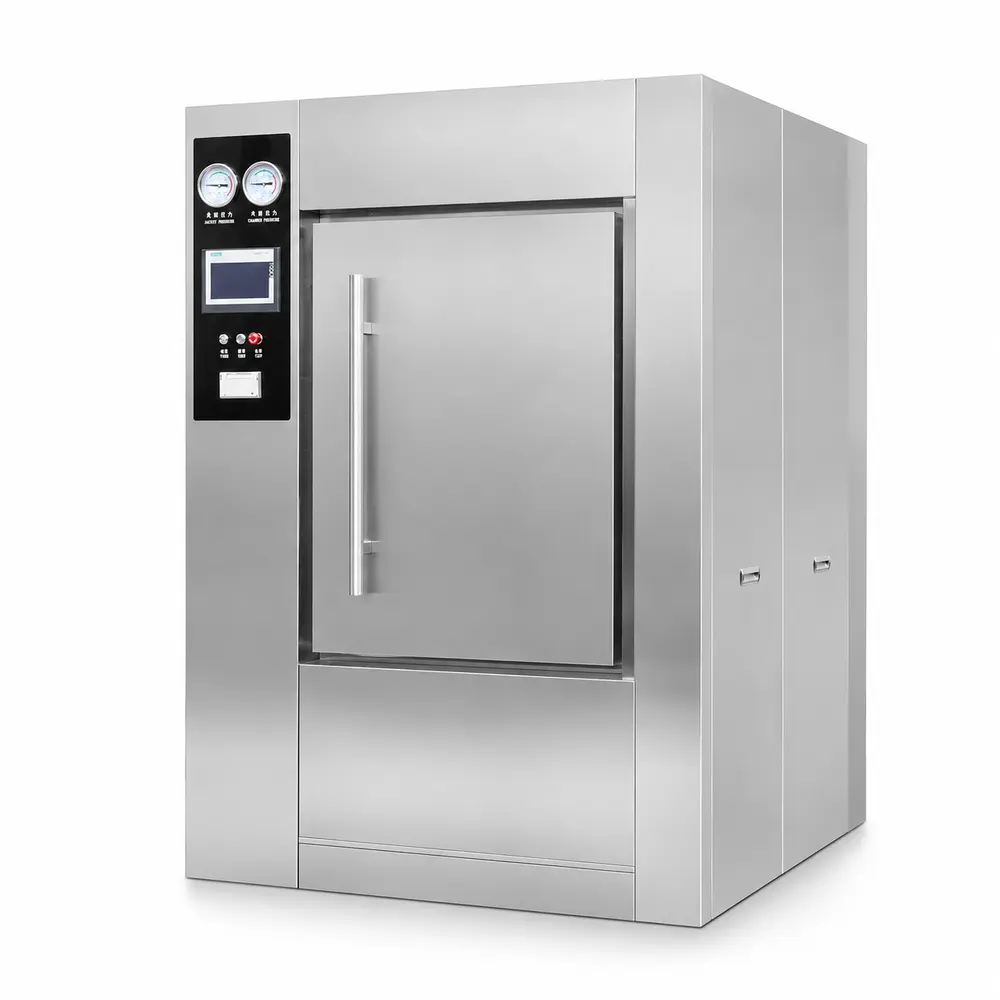
Horizontal steam sterilizers are commonly planned for CSSD environments because they can support defined loading and unloading zones and a clear flow between the preparation side and the sterile side. Review the available Horizontal Autoclaves range as part of the equipment comparison, while treating the final chamber selection as an engineering and workflow decision.
Measure the complete installation area, including door swing or door travel, service clearance, loading trolley movement, drainage, steam or electrical connections, ventilation and access for maintenance. A chamber that fits on a drawing may still be unsuitable if operators cannot safely manoeuvre a loaded trolley or if doors, lifts and corridors restrict delivery and installation.
For pass-through arrangements, verify the physical separation between dirty and clean areas and define how doors, interlocks, status indicators and documentation will support the CSSD process. The chamber should fit the department's infection-control layout and operating procedures, not force staff to create unsafe workarounds.
- Confirm clearances on both loading and unloading sides.
- Check trolley dimensions, turning radii and floor loading.
- Coordinate utilities with the building and medical engineering teams.
- Plan maintenance access before finalising the room layout.
Allow for load types, standards and usable volume
Chamber sizing must reflect the loads that the hospital actually processes. Wrapped instruments, porous textiles, hollow devices, rigid containers and liquid loads can have different air-removal, exposure, drying and cooling requirements. A chamber that appears large enough by geometric volume may have less practical capacity when spacing and load support requirements are applied.
EN 285 is relevant to large steam sterilizers, while EN 13060 addresses small steam sterilizers. EN ISO 17665 provides a framework for developing, validating and routinely controlling moist heat sterilisation processes, and EN 868 covers packaging materials and systems used for sterilisation. These standards describe general requirements and process principles; the hospital must confirm how they apply to its equipment, loads, quality system and local regulations.
Ask suppliers for the information needed to complete a site-specific evaluation: usable loading arrangement, compatible load categories, cycle descriptions, utility requirements, trolley interfaces, installation clearances, routine monitoring provisions and maintenance access. The equipment selection should be reviewed with infection prevention, CSSD operations, biomedical engineering and facilities personnel.
| Planning factor | Questions to answer | Sizing implication |
|---|---|---|
| Workload | How many STU are required on an average and peak day? | Sets the total capacity target. |
| Cycle performance | What is the complete door-to-door turnaround for each load type? | Determines the number of practical cycles. |
| Load mix | Are loads mainly small sets, containers, textiles, hollow items or liquids? | Determines usable rather than geometric capacity. |
| Continuity | What happens during maintenance, repeat cycles or urgent demand? | May support two or more chambers. |
| Room and utilities | Are access, clearances, drainage, power, steam and ventilation adequate? | Limits the feasible chamber arrangement. |
Validate the autoclave chamber size with a workload model
Before issuing a purchase specification, build a simple hourly workload model. Enter expected loads by hour, assign each load an STU estimate and cycle category, then test normal, peak, emergency and reduced-availability scenarios. The model should show whether instruments can move from washer release to sterile storage without excessive queue time.
Include realistic losses: loading errors, cooling delays, documentation, biological or chemical monitoring procedures, repeat processing and staff breaks. If the calculation only works when every cycle starts immediately and every chamber is completely full, the proposed capacity is too tight for hospital operation.
Use the model to compare arrangements such as one larger chamber, two medium chambers or several smaller chambers. The best option is usually the one that meets peak demand with manageable queues, supports the CSSD layout and preserves useful capacity when load sizes change. For project-specific questions, consult the autoclave FAQ and prepare a written list of load, room and utility conditions.
Prepare a clear procurement specification
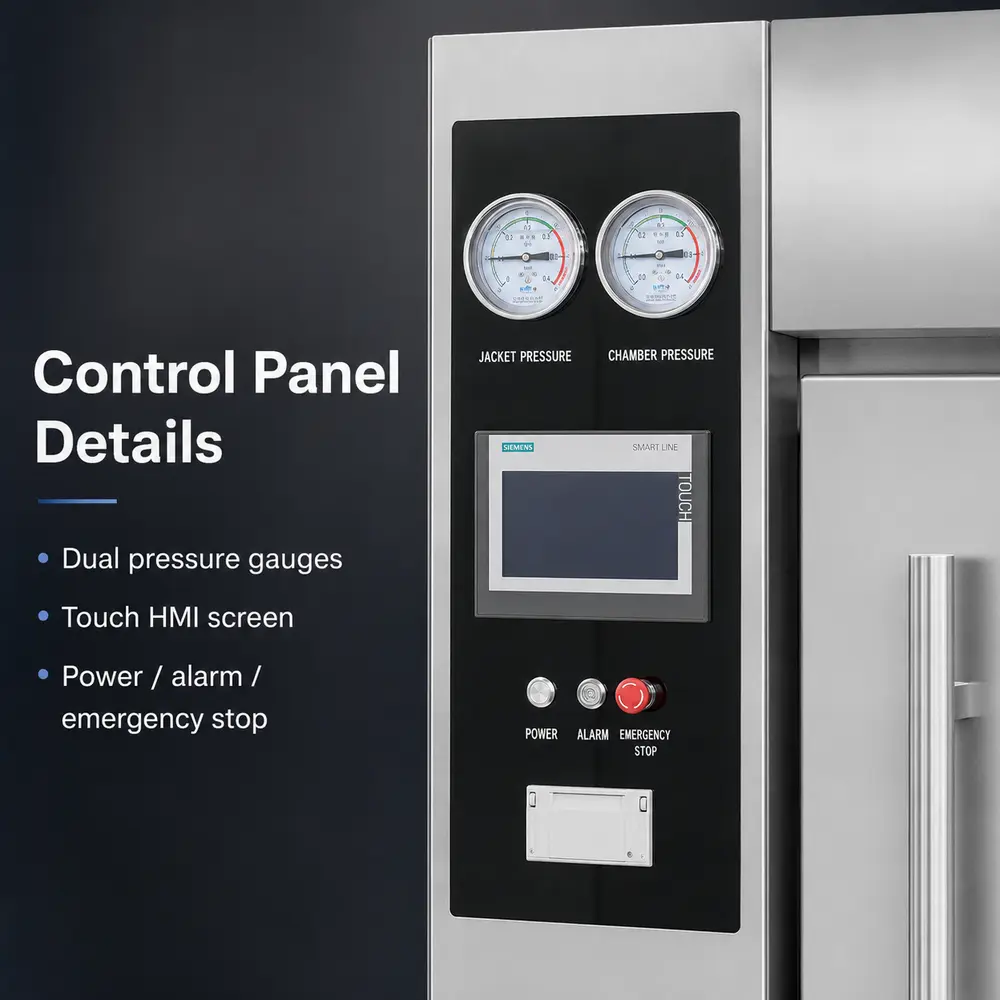
A tender or purchase specification should state the required workload in STU, the peak operating window, the assumed complete turnaround time and the load categories to be processed. It should also define the preferred chamber arrangement, loading equipment, data recording, operator controls, safety functions, maintenance access and training requirements without prescribing an unsuitable volume too early.
Request drawings showing external dimensions, door movement, service zones, trolley interfaces and connection points. Ask suppliers to identify assumptions behind usable capacity and cycle time, because nominal chamber volume alone is not enough for a reliable comparison. The CSSD should also review how the proposed system will be tested, documented and integrated into its quality procedures.
When technical questions remain, send the workload model, floor plan and utility information to our export team for clarification. A structured exchange at this stage helps prevent a chamber that is physically large but operationally difficult, or a smaller system that cannot support future demand.
- Specify peak STU demand and not only daily instrument count.
- Define complete turnaround time for each important load category.
- Compare one- and multi-chamber arrangements using the same assumptions.
- Require dimensional drawings and utility data for site review.
- Include future workload growth and service continuity in the evaluation.
Key points
- Calculate autoclave chamber size from peak STU demand and practical cycles, not daily item count alone.
- Use complete door-to-door turnaround time, including loading, drying, cooling and handling.
- Treat STU as a loading reference and verify usable capacity for each load category.
- Two smaller chambers often provide better flexibility and continuity than one oversized chamber.
- Check room layout, utilities, trolley movement and maintenance access before finalising the chamber.
- Validate the preferred arrangement with an hourly workload model and realistic operating assumptions.
Frequently asked questions
What does STU mean when sizing an autoclave chamber?
STU means sterilisation unit and provides a standard reference for comparing chamber loading capacity. In EN 285 planning terminology, one STU is commonly represented by a 300 x 300 x 600 mm space, or about 54 litres of geometric volume. Actual usable capacity depends on load spacing, packaging, supports and cycle requirements.
How many STU should a hospital sterilizer process per cycle?
The answer depends on peak demand, operating hours and complete turnaround time. Divide the STU required during the target period by the number of practical cycles available, then add reasonable allowance for peaks, repeats and interruptions. The result should be checked against the actual load mix rather than used as a purely theoretical number.
Is one large autoclave better than two smaller chambers?
Not usually when the CSSD handles varied load sizes or requires continuity during maintenance. Two chambers can provide better flexibility, partial availability and more efficient processing of small loads. One large chamber may be suitable where full loads are frequent and the facility has the space, utilities and workflow to support it.
Should chamber size be based on daily instrument sets?
Daily instrument sets are a useful starting point, but item count alone is insufficient. Convert each load into an STU estimate and include load type, packaging, spacing, cycle category and peak timing. A workload model gives a more reliable capacity requirement.
What information should be sent to a supplier before requesting a quotation?
Provide the estimated average and peak STU demand, load categories, operating hours, required turnaround, room drawings, access routes and available utilities. Also describe trolley dimensions, pass-through needs, maintenance expectations and future expansion plans. This allows the supplier to discuss a workable arrangement instead of comparing chamber volume alone.
Discussing a specific project?
Send the load type, throughput and destination country. The export team replies with the models that fit and the documents you will need.
Contact the export teamSee Horizontal Autoclaves