
Loading and Packaging Rules That Decide Whether a Cycle Succeeds
Successful autoclave loading depends on allowing steam to contact every exposed surface and air to leave the chamber and load. Overloading, unsuitable packaging, incorrect orientation and a cycle that does not match the load can produce wet packs, incomplete air removal or an unprocessed item.
Why autoclave loading determines cycle performance
A steam sterilization cycle is a controlled sequence of air removal, steam admission, exposure, pressure reduction and drying. The sterilizer can control chamber conditions, but it cannot correct a load that blocks steam pathways, traps air or holds excessive condensate. For this reason, loading is part of the validated process rather than a simple housekeeping task.
Overloading increases the thermal mass and restricts circulation around trays, containers and wrapped items. Dense loads may take longer to reach the required sterilization conditions, while the centre of a tightly packed load can behave differently from the chamber sensors. The result may be poor drying, cold spots, wet packaging or a cycle that cannot be accepted under the facility's release procedure.
Buyers should therefore evaluate chamber volume together with usable loading space, rack design, drain location, loading aids and the intended mix of instruments, textiles, containers and porous goods. A large nominal chamber is not automatically suitable if the working load cannot be arranged with adequate clearance.
- Treat the load pattern as part of the process specification.
- Keep a written loading configuration for routine load families.
- Do not use chamber capacity alone as the maximum working load.
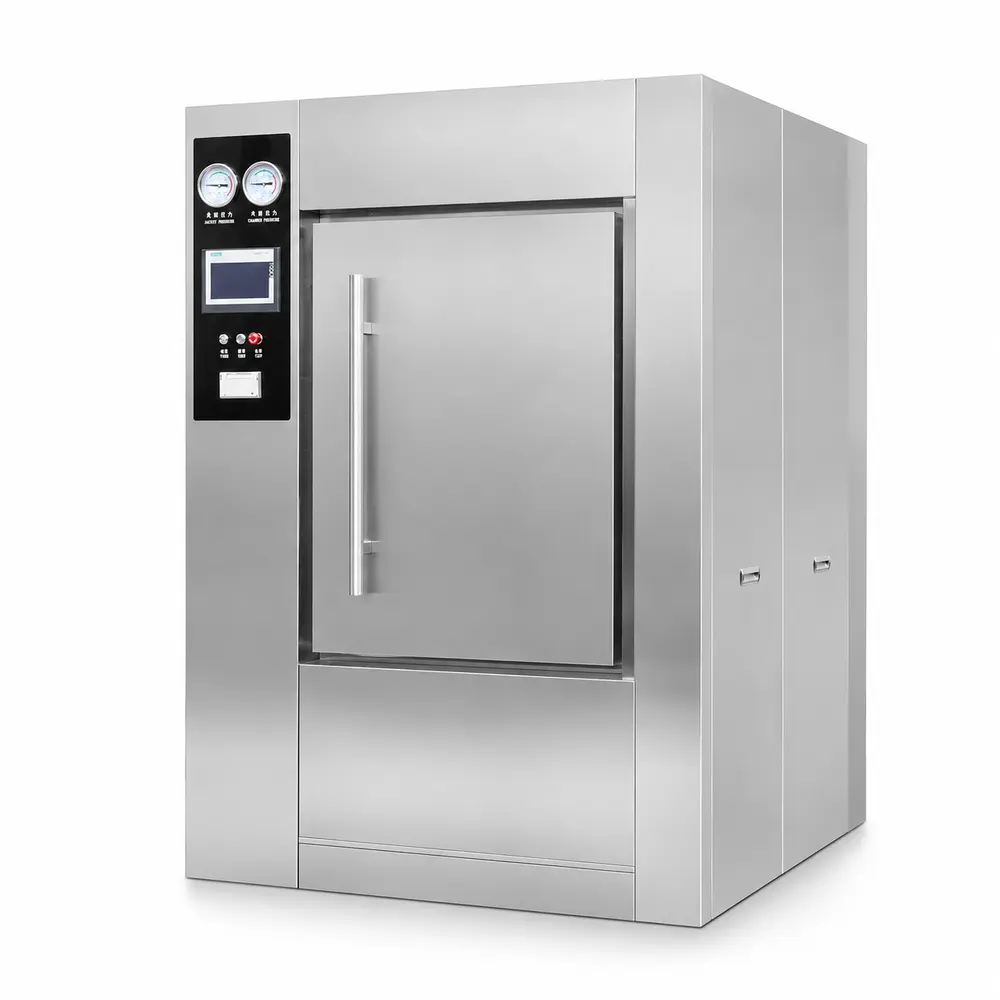
Autoclave loading: spacing, mass and chamber arrangement
Leave open pathways between packages so that steam can circulate and condensate can drain. Packages should not be pressed against the chamber wall, ceiling, door or drain area. The exact clearance depends on the chamber design and loading system, so the equipment instructions and the site's validated loading pattern take priority over a universal distance.
Avoid stacking heavy trays on delicate pouches or compressing wrapped goods. Heavy containers should be supported by the rack and positioned so that their weight does not deform packaging or prevent free drainage. If a load requires shelves or baskets, those accessories should support separation rather than create a solid block.
The following planning table describes general loading principles. It is not a substitute for the sterilizer manufacturer's instructions, local procedures or a documented process qualification.
| Load form | Recommended arrangement | Main risk when poorly arranged |
|---|---|---|
| Wrapped instrument trays | Place with space between trays; avoid compressing wraps and keep heavy trays supported | Restricted steam contact, trapped air and wet packs |
| Pouches | Arrange in a single layer or an open, separated pattern with the paper side positioned as instructed for the packaging system | Pouches sticking together, poor drying or blocked steam penetration |
| Rigid containers | Use approved racks or baskets and orient lids, valves and drainage features according to the container instructions | Air retention, condensate pooling or impaired drying |
| Textiles and porous goods | Loosely arrange and avoid tight compression; allow space around the load | Poor air removal, uneven heating and retained moisture |
Correct orientation for pouches, trays and containers
Pouches should not be laid in a tightly overlapping pile. They need an arrangement that exposes the sterilization surface and permits air removal and drying. In many loading systems, pouches are placed edge-on or in a separated shingled pattern, but the correct orientation must follow the packaging supplier's instructions and the sterilizer's validated procedure.
Wrapped trays should be positioned so that the wrap is not folded against a shelf or compressed by another load. If trays are placed one above another, the rack must maintain separation and prevent the upper tray from forcing the lower wrap into contact with a wet or obstructed surface. The largest or heaviest items normally require the most deliberate placement.
Rigid containers need particular attention to lids, filters, valves and condensate drainage. A container should be loaded only with its approved accessories and with the opening or drainage path oriented as instructed. Do not improvise by sealing a container in a way that prevents pressure equalization or steam access.
- Keep pouches separated rather than flat-stacked under pressure.
- Prevent wrapped items from touching chamber surfaces where condensate may collect.
- Orient containers so air can escape and condensate can drain.
- Check that lids, filters and valves are correctly fitted before loading.
Packaging choices that prevent wet packs
Packaging must permit steam penetration and allow moisture to leave during drying. Materials, seals, filters and closure methods should be suitable for the intended sterilization process. A package that is too dense, too tightly wrapped or damaged before the cycle may remain wet even when chamber conditions appear correct.
Wet packs are often caused by a combination of factors rather than one defect. Excessive load mass creates more condensate; close stacking prevents evaporation; cold items can promote condensation; and unsuitable packaging can retain moisture. Loading a warm, dry chamber with clean, correctly prepared items is also important because residual water, detergent or heavy soil can interfere with drying and processing.
Packaging selection should be documented by load family. EN 868 addresses packaging materials and systems for terminally sterilized medical devices; buyers should confirm that the proposed packaging, sealing method and load pattern are appropriate for the intended steam process rather than assuming that every wrap or pouch is interchangeable.
- Inspect seals, filters, wraps and pouches before loading.
- Do not process visibly damaged, wet or contaminated packaging as a normal load.
- Avoid packaging configurations that create closed pockets or excessive layers.
- Investigate repeated wet packs before simply extending the cycle.
Match the cycle to the actual load composition
The correct cycle is determined by the load's materials, geometry, porosity, packaging and thermal mass. A cycle intended for solid unwrapped items should not automatically be used for wrapped porous goods or hollow instruments. Buyers should specify the load families they expect to process and require the sterilizer selection, cycle menu and accessories to reflect those families.
Pre-vacuum systems are commonly selected where air removal from wrapped, porous or hollow loads is important. Gravity or other cycle arrangements may be suitable for specific load types, but suitability depends on the item design, packaging and applicable instructions. EN 13060 classifies small steam sterilizer cycle types, while EN 285 addresses larger steam sterilizer requirements; these standards should be considered alongside the device and packaging instructions.
The table below is a procurement planning aid. It uses functional descriptions rather than assigning a cycle to every product. The final cycle parameters and load limits should be established through the equipment documentation and the user's process validation.
| Load characteristic | Cycle capability to consider | Buyer verification point |
|---|---|---|
| Solid, unwrapped instruments | A cycle intended for exposed solid loads with appropriate drying control | Confirm the permitted item condition and release procedure |
| Wrapped instruments and porous goods | Effective air removal, steam penetration and drying for the defined packaging system | Request documented load patterns and packaging compatibility |
| Hollow or narrow-lumen items | Air removal and steam penetration capability suited to the item's geometry | Check the device instructions and any required loading accessories |
| Liquid loads | A liquid-compatible process with controlled heating, cooling and pressure changes | Confirm container type, fill limits and safe handling procedure |

How buyers should specify loading capability
A useful tender or purchase specification describes more than chamber dimensions. It should identify the expected daily load, the heaviest routine load, the proportion of wrapped and porous goods, the number of trays or baskets, the presence of hollow instruments and whether liquids are required. It should also state how loads will be released and what records are needed for traceability.
Ask suppliers to explain the usable loading configuration, rack and basket arrangement, maximum permitted load for each cycle family and the controls that prevent an unsuitable cycle from being selected. The buyer should also request sample loading diagrams or operating guidance for representative loads, without treating a generic chamber capacity as a validated load limit.
For a hospital CSSD, Horizontal Autoclaves may be relevant where routine loads require rack-based handling and a larger working chamber. Laboratory, dental and clinic buyers may instead need a different chamber format or accessory set. The correct choice follows the load profile, not the equipment label alone.
- Define load families before comparing cycle menus.
- Specify racks, baskets, supports and loading aids as part of the system.
- Ask how cycle selection and load limits are communicated to operators.
- Include staff training, routine monitoring and maintenance access in the purchase review.

Operator checks before and after every cycle
Before loading, inspect items for cleanliness, damage, residual water and correct assembly. Confirm that packaging is intact, containers are correctly closed but able to equalize pressure, and pouches or wraps are compatible with the selected process. Check that the chamber, rack and drain area are clear and that the load does not exceed the documented configuration.
After the cycle, inspect dryness, packaging integrity, indicators and the cycle record according to the facility's procedure. A wet pack, torn wrap, displaced pouch or abnormal record should be treated as a process signal, not hidden by immediate reprocessing. Segregate the affected load and investigate loading, packaging, air removal, steam quality, drainage and equipment condition.
EN ISO 17665 provides a framework for the development, validation and routine control of moist heat sterilization processes. In practice, the facility should connect its loading instructions, monitoring program, maintenance plan and release criteria so that operators can identify a deviation and respond consistently.
- Verify the selected cycle against the actual load family.
- Record unusual loading conditions and repeated wet-pack events.
- Do not release items solely because the cycle completed without an alarm.
- Use the autoclave FAQ for general operating questions and escalate equipment-specific issues through the documented support route.
Build a repeatable loading procedure
A repeatable procedure should show where each load family is placed, which racks or baskets are used, how pouches are oriented and what maximum quantity is permitted. Photographs or simple diagrams can reduce operator variation, especially when several shifts share one sterilizer. The procedure should be reviewed whenever packaging, instruments, accessories or cycle settings change.
Training should explain why spacing and orientation matter, not only what pattern to copy. Operators who understand the relationship between air removal, steam contact, condensation and drying are more likely to recognize an unsafe or unsuitable load before starting the cycle.
For a new installation or a changed load, the buyer should coordinate with the responsible quality team and supplier to define commissioning, validation and routine monitoring activities. Contact our export team when you need to discuss a load profile, chamber arrangement or application requirement for equipment selection.
Key points
- Autoclave loading is part of the sterilization process and must be controlled like any other process variable.
- Overloading and compressed packaging restrict steam circulation, trap air and increase the risk of wet packs.
- Pouches, wrapped trays and rigid containers need separate orientation and support rules.
- Cycle selection must reflect the load's porosity, geometry, packaging, mass and liquid content.
- Buyers should specify load families, accessories, loading patterns and documentation requirements before comparing equipment.
- Repeated wet packs require investigation of loading, packaging, drainage, steam and equipment condition.
Frequently asked questions
Can a sterilizer be filled to its stated chamber capacity?
Not necessarily. Nominal chamber volume is different from the usable load capacity for a particular cycle and packaging arrangement. The documented loading pattern, item mass, spacing and cycle instructions should determine the permitted working load.
Why are packs wet after a cycle that completed normally?
Possible causes include overloading, insufficient spacing, excessive condensate, unsuitable packaging, poor drainage, cold items or a cycle that does not match the load. Review the load pattern and packaging first, then investigate equipment and steam conditions if the problem continues.
Should pouches be laid flat or placed upright?
The correct arrangement depends on the pouch system, rack design and sterilizer instructions. Pouches should be separated and positioned to support steam contact, air removal and drying; tightly overlapping stacks should be avoided.
Can one cycle process wrapped instruments and solid unwrapped items together?
Only when the cycle and loading procedure are specifically suitable for the complete mixed load. The most demanding item, packaging system and load geometry must be considered, and the facility should document and validate the mixed configuration before routine use.
What information should a buyer provide when requesting an autoclave?
Provide the load families, packaging types, dimensions and mass of representative loads, required throughput, hollow or porous items, liquid requirements, rack preferences and documentation needs. This information allows the supplier to discuss a suitable chamber arrangement and cycle capability without relying on volume alone.
Discussing a specific project?
Send the load type, throughput and destination country. The export team replies with the models that fit and the documents you will need.
Contact the export teamSee Horizontal Autoclaves