
Sterilizer Tender Specification: A Checklist That Avoids Disputes
An effective autoclave tender specification defines measurable sterilization, safety, installation and service requirements instead of copying brand-specific wording. It should also state the evidence required at tender review, factory acceptance, site acceptance and throughout the warranty period.
Start with the service need, not a copied autoclave tender specification
A tender should begin by describing the work the sterilizer must perform: instrument reprocessing, laboratory waste treatment, textile loads, porous goods, liquids or other defined applications. State the expected load types, daily workload, available utilities, room constraints, operator profile and required workflow. This gives suppliers enough information to propose a suitable configuration without forcing a hidden brand reference.
Use performance-based language wherever possible. For example, require repeatable air removal, saturated-steam exposure, controlled drying where relevant, recorded cycle data, operator safeguards and defined recovery between cycles. Avoid wording that names an unusual panel layout, proprietary menu term, exact component arrangement or copied catalogue sentence unless that feature is genuinely essential to the clinical or laboratory process.
Separate mandatory requirements from preferred features. A compliance schedule should let each bidder answer compliant, partially compliant or non-compliant, with a reference to supporting evidence. Any deviation should be described clearly rather than accepted through an ambiguous statement such as equivalent.
- Define the load categories and maximum intended workload before selecting chamber or door arrangements.
- Describe required utilities, drainage, ventilation, water quality and room access conditions.
- State which requirements are mandatory, which are desirable and which are subject to clarification.
- Require a point-by-point compliance response with documentary evidence.

Make the autoclave tender specification measurable
Every important clause should answer four questions: what must the equipment do, under what conditions, how will it be measured, and what evidence will prove compliance? This approach turns general expectations into contract obligations. It also reduces disputes caused by different interpretations of terms such as rapid, automatic, high capacity or suitable for all loads.
Define the cycle families needed for the stated load types rather than demanding one cycle for every application. A pre-vacuum cycle is generally relevant to wrapped or porous loads, while gravity displacement may be suitable for some simpler loads. Liquid cycles require controlled heating, exposure and cooling to limit boil-over and container damage; the final selection must follow the load manufacturer’s instructions and the facility’s validated process.
Reference recognized standards where they help define the technical framework. EN 285 is relevant to large steam sterilizers, EN 13060 addresses small steam sterilizers, EN ISO 17665 provides a framework for developing, validating and routinely controlling moist-heat sterilization processes, and EN 868 addresses packaging systems and materials. The tender should state which standard is applicable to the use case and should request a compliance statement or test evidence without assuming that a particular product is certified.
| Tender topic | Performance wording | Evidence to request |
|---|---|---|
| Cycle control | The controller shall manage the defined phases and prevent progression when critical conditions are not met. | Functional description, alarm list, sample cycle record and acceptance-test procedure. |
| Process records | Each completed cycle shall provide an identifiable record showing the defined critical parameters and cycle status. | Sample printout or electronic record, data-export format and retention method. |
| Load compatibility | The bidder shall identify which specified load categories are covered by each proposed cycle and any restrictions. | Cycle matrix, user instructions and load-specific validation guidance. |
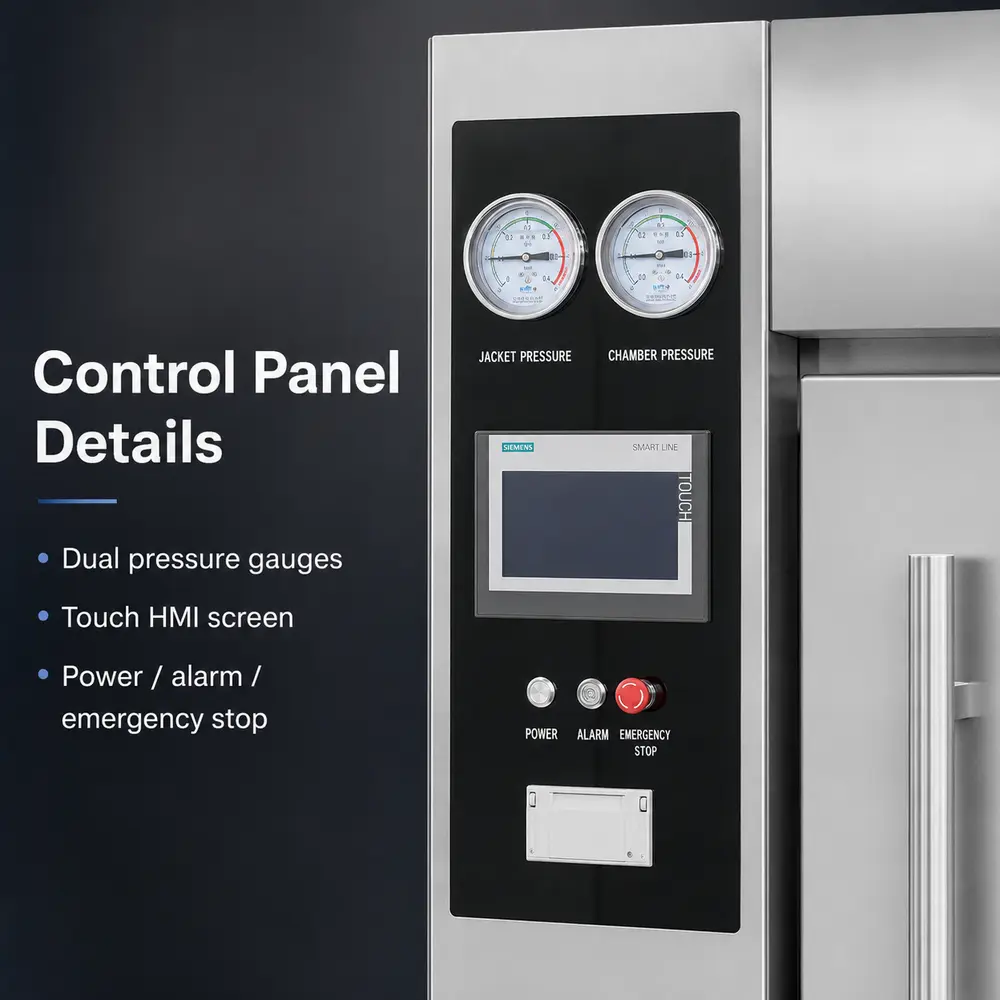
| Safety | The equipment shall include safeguards for door locking, pressure release, overheating and operator access to hazardous conditions. | Risk assessment summary, safety-function description and acceptance-test checks. |
Require a complete document package before award
Documents should be part of the technical offer, not an afterthought supplied only after delivery. The tender committee should be able to review the proposed cycle logic, utility requirements, chamber and loading arrangements, maintenance access, safety functions and limitations before making a technical recommendation.
Ask for controlled documents with revision numbers and clear identification of the offered configuration. The package should distinguish standard documentation from optional items and should identify any subcontracted software, instruments or accessories. Where a supplier proposes an alternative, require a marked deviation schedule showing the effect on operation, validation, installation or future maintenance.
A useful tender file also defines the documents to be delivered at handover. These normally include operation and maintenance manuals, installation drawings, wiring and utility diagrams, recommended preventive-maintenance schedules, spare-parts lists, calibration information for relevant instruments, troubleshooting guidance, software or data-management instructions and training records.
- Technical offer and completed compliance matrix.
- General arrangement, loading diagram and utility schedule.
- Cycle descriptions, alarm list and sample records.
- Installation, operation, maintenance and cleaning instructions.
- Recommended spare-parts list with part identification and interchange controls.
- Risk, safety and decontamination information appropriate to the intended loads.
Define factory and site acceptance tests in the autoclave tender specification
Factory acceptance testing (FAT) verifies the offered equipment before shipment. The tender should state whether the buyer may attend in person or remotely, how much notice is required, which test instruments will be used, and how test results will be recorded. FAT should cover configuration, workmanship, door and interlock operation, alarms, control sequences, data records, utilities, accessories and the agreed cycle demonstrations.
Site acceptance testing (SAT) verifies the installed system under the buyer’s actual conditions. It should begin only after installation, utility connection, operator access, drainage, ventilation and environmental requirements have been checked. SAT can include empty-chamber checks, required process tests, record review, alarm simulation, load-handling demonstrations and confirmation that the equipment interfaces correctly with the facility’s workflow.
The contract should explain what happens when a test fails. Specify a corrective-action process, retest responsibility, treatment of minor punch-list items and the point at which provisional acceptance becomes final acceptance. Do not rely on a supplier’s statement that a unit has passed internal testing; define the witness rights, acceptance criteria and records that the purchaser will receive.
| Stage | Purchaser should verify | Supplier should provide |
|---|---|---|
| FAT preparation | Approved test protocol, witness arrangements and agreed configuration. | Test schedule, calibrated instruments or traceable measurement records, and test documentation. |
| FAT execution | Observed functions, deviations and outstanding actions. | Demonstration of controls, alarms, safety functions, records and agreed cycles. |
| Installation review | Room readiness, utilities, access, drainage, ventilation and local responsibilities. | Installation instructions, connection requirements and commissioning checklist. |
| SAT execution | Performance under site conditions, operator workflow and required records. | Commissioning support, corrective actions, training and final handover documents. |
| Acceptance closeout | Signed punch list and approval of final documentation. | Retest results, corrected drawings, training records and acceptance dossier. |
Write training requirements that can be verified
Training should cover more than switching on the sterilizer. Require separate learning objectives for operators, supervisors, maintenance staff and infection-control or quality personnel where appropriate. Topics may include load preparation, packaging, loading patterns, cycle selection, unloading precautions, failed-cycle response, routine cleaning, record review and escalation of faults.
State the minimum training format and evidence. A useful requirement identifies the number of sessions or user groups without inventing a universal duration, specifies the language of instruction, requires practical demonstrations and records attendance and competency. Refresher training should be required after major software changes, process changes, extended interruption or repeated user errors.
The purchaser should retain training materials that match the delivered configuration. Include a quick-reference guide for routine operation, a fault-response flowchart and instructions for contacting service support. Link the training content to the facility’s standard operating procedures rather than allowing the supplier’s manual to become the only operational control.
- Define the user groups and learning outcomes.
- Require practical demonstrations and documented attendance.
- Include failed-cycle handling, load release and incident escalation.
- Provide maintenance and troubleshooting training for authorized technical staff.
- Require updated materials after agreed configuration or software changes.
Control spare parts, service and warranty terms
A warranty clause is enforceable only when its scope and exclusions are clear. Define the start point, covered equipment and accessories, treatment of defects, labor and travel responsibilities, response process, repair documentation and the method for handling repeated failures. Also state what conditions could invalidate coverage, such as unauthorized modifications, unsuitable water, incorrect loading or missed maintenance, and ensure those conditions are objectively documented.
Spare-parts provisions should address the expected support period, identification of critical parts, recommended stock for routine maintenance and the process for approving substitutions. Ask for parts lists with functional descriptions and service intervals rather than relying only on internal codes. The tender may require a service plan, escalation contacts, remote diagnostic arrangements where appropriate and a clear distinction between corrective and preventive maintenance.
Avoid promising an undefined availability level. Instead, require bidders to state their service model, support channels, documentation, responsibilities and any assumptions. The buyer can then evaluate whether the proposed arrangement is suitable for its risk level, local technical capability and continuity requirements. Potential suppliers can be directed to our export team for clarification of documentation and support arrangements.
| Clause area | Question the tender should answer | Required record |
|---|---|---|
| Warranty start | Does coverage begin at delivery, commissioning, site acceptance or another defined event? | Signed delivery, commissioning or acceptance record. |
| Defect handling | How are faults reported, assessed, corrected and closed? | Service report with fault description, action and closure date. |
| Preventive maintenance | Which tasks are required, by whom and at what intervals? | Maintenance log and completed checklist. |
| Parts support | Which critical parts are recommended and how are approved alternatives controlled? | Parts list, identification method and substitution record. |
| Training and misuse | Which user actions, utilities or modifications affect warranty responsibility? | Training records, utility checks and documented investigation. |
Use a fair evaluation and clarification process
Tender evaluation should score technical compliance separately from commercial considerations. A weighted model can assess process suitability, safety, documentation, maintainability, training, lifecycle support and acceptance methodology. The scoring notes should explain how partial compliance, exceptions and missing evidence are treated so that bidders are evaluated consistently.
Clarifications should be written and shared according to the procurement rules. If one bidder identifies an ambiguous clause, issue the answer or amendment to all bidders. Do not allow a private discussion to change the required performance after submission; that creates a dispute risk and may undermine equal treatment.
Before award, reconcile the technical offer with the draft contract, FAT and SAT protocols, drawings, accessories, training scope, spare parts and warranty schedule. For complex installations, a short design review can identify conflicts between room layout, utility capacity, drainage, workflow and the proposed loading equipment. The final contract should contain the exact configuration and all accepted deviations.
- Publish definitions for compliance, deviation, clarification and acceptance.
- Score evidence and lifecycle risk, not only purchase cost.
- Issue shared addenda for material changes or answers.
- Attach the final compliance matrix to the purchase contract.
- Record all accepted deviations and their operational consequences.
Turn the autoclave tender specification into an operating contract
A strong specification continues to be useful after installation. It becomes the reference for commissioning, validation planning, staff training, maintenance, incident review and future replacement of consumables or parts. Organize the handover file so CSSD managers, laboratory supervisors, biomedical engineers and auditors can find the same agreed information.
The specification should also state who owns process validation and routine monitoring. EN ISO 17665 provides a framework for moist-heat process development and control, but the facility must relate the process to its actual loads, packaging, equipment configuration and quality system. Routine monitoring and periodic review should be defined by the purchaser’s procedures and applicable local requirements.
For equipment selection information, readers may review Horizontal Autoclaves and consult the autoclave FAQ for general purchasing questions. These links should support the tender process, not replace the project-specific compliance schedule, risk assessment or acceptance protocol.
- Keep the tender, contract, FAT, SAT and handover records under document control.
- Assign responsibility for validation, routine monitoring and release of loads.
- Review cycle records, alarms, maintenance findings and user feedback after commissioning.
- Update procedures when loads, packaging, utilities or software change.
- Use the original compliance matrix during warranty reviews and service meetings.
Key points
- Write around load types, workflow and measurable performance rather than copied brand language.
- Require a point-by-point compliance matrix and a complete document package before award.
- Define FAT, SAT, pass criteria, witness rights, retesting and punch-list closeout in the contract.
- Make training practical, role-specific and supported by attendance and competency records.
- Clarify warranty scope, preventive maintenance, critical spares and service responsibilities.
- Use the final specification as the controlled reference for commissioning, validation and lifecycle support.
Frequently asked questions
What is the most important feature of an enforceable autoclave tender specification?
It should define measurable performance requirements and the evidence used to verify them. Each critical clause should identify the operating conditions, acceptance method, responsible party and required record. This is more reliable than copying wording from an unspecified catalogue.
Should a tender name a sterilizer class?
Only when the class matches the intended loads, process and applicable framework. Small steam sterilizer classifications under EN 13060 should not be applied automatically to every installation, while larger systems may need consideration under EN 285 and EN ISO 17665. The purchaser should state the load and process need first, then define the applicable requirements.
What should be tested during factory acceptance?
FAT should verify the agreed configuration, controls, safety functions, alarms, door operation, records, accessories and representative cycle sequences. The test protocol should identify pass criteria, instruments, witness rights and the process for correcting failures. FAT does not replace verification under the purchaser’s actual site conditions.
When should site acceptance take place?
SAT should occur after installation and utility checks are complete and the equipment is safe to operate. It should verify the required functions, records, alarms, workflow and agreed process tests in the installed environment. Final acceptance should depend on completed corrective actions and delivery of the required documentation.
How can warranty disputes be reduced?
Define the warranty start date, covered items, response and repair process, exclusions, maintenance duties and required records. Include objective evidence for alleged misuse or unsuitable utilities, and require written closure of service events. A linked spare-parts and training plan further reduces disagreements about responsibility.
Discussing a specific project?
Send the load type, throughput and destination country. The export team replies with the models that fit and the documents you will need.
Contact the export teamSee Horizontal Autoclaves