
Pre-Vacuum vs Gravity Displacement Steam Sterilizers
A pre vacuum autoclave removes air from the chamber and load with one or more vacuum pulses before steam exposure, while a gravity displacement sterilizer uses incoming steam to push air downward and out through a drain. Fractionated pre-vacuum is generally preferred for wrapped, porous, hollow or densely arranged loads; gravity displacement remains practical for simple, unwrapped solid items and routine applications that do not require deep air removal.
Pre Vacuum Autoclave and Gravity Sterilizer: The Basic Difference
Both systems sterilize by exposing the load to saturated steam at a controlled temperature, pressure and holding time. The decisive difference is how effectively they remove air before the exposure phase. A pre vacuum autoclave actively extracts air, whereas a gravity displacement unit relies mainly on the natural movement of heavier air as steam enters the chamber.
Air is an insulator and does not condense like saturated steam. If it remains around an instrument, inside a pouch, or within a porous pack, the local surface may not receive the required steam conditions even though the chamber sensor indicates that the target temperature has been reached.
| Characteristic | Fractionated pre-vacuum | Gravity displacement |
|---|---|---|
| Air removal | Repeated vacuum and steam admission pulses actively extract air | Incoming steam displaces air toward the drain |
| Steam penetration | Better for wrapped, porous and hollow items when correctly loaded | Most effective with simple solid loads and open arrangements |
| Packaging compatibility | Commonly selected for wrapped or packaged instruments | More limited; packaging and load configuration require careful evaluation |
| Process complexity | More controlled air removal, with additional equipment and controls | Simpler cycle principle and generally less demanding for basic loads |
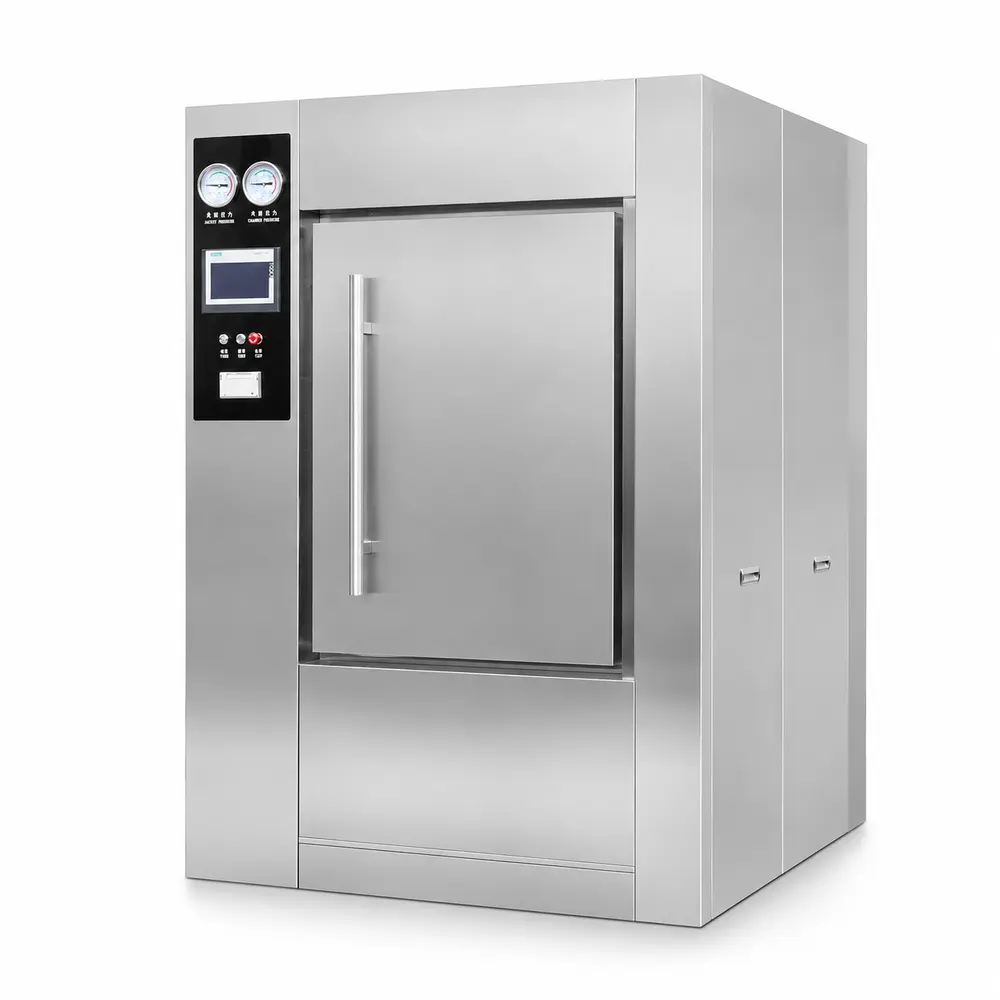
How a Pre Vacuum Autoclave Removes Air
In a fractionated pre-vacuum cycle, the chamber first undergoes a vacuum pulse. Steam is then admitted, and the sequence may be repeated several times. Each pulse reduces the amount of trapped air, including air in porous materials and accessible internal spaces, before the sterilization holding period begins.
After air removal, saturated steam must contact all relevant surfaces and condense there. The control system monitors parameters such as chamber temperature, pressure and time, while the load configuration, packaging, drainage and drying conditions determine whether the intended process reaches the entire load. A vacuum phase after exposure may also help remove condensate and improve drying.
For large hospital steam sterilizers, EN 285 describes relevant design and performance principles. For smaller steam sterilizers, EN 13060 classifies cycle types and load applications. EN ISO 17665 provides a framework for developing, validating and routinely controlling moist-heat sterilization processes; the applicable standard and local requirements should be confirmed for each installation.
- Use validated loading patterns rather than filling the chamber as tightly as possible.
- Keep pouches, trays and porous packs arranged so steam can circulate and condensate can drain.
- Investigate failed air-removal or penetration tests before releasing the load.
How Gravity Displacement Steam Sterilizers Remove Air
A gravity displacement sterilizer admits steam into the upper part of the chamber. Because steam is less dense than air, it pushes air downward toward the drain. The process depends on sufficient steam flow, an open drain path and enough time for air to leave the chamber.
This approach can work well when the load is uncomplicated, open and arranged to allow free circulation. It is less effective when air is trapped in narrow lumens, dense porous materials, tightly packed containers or sealed packaging. A chamber can therefore reach the selected temperature while a protected location remains inadequately exposed.
Gravity cycles may also require careful attention to drying. Condensate can collect when steam contacts cooler instruments or when drainage is restricted. Wet packs are not merely a handling inconvenience; moisture can compromise packaging integrity and increase the risk of contamination after the cycle.
| Load feature | Preferred starting point | Reason for review |
|---|---|---|
| Unwrapped, solid metal instruments | Gravity may be appropriate | Air can usually escape readily when items are open and separated |
| Wrapped instrument sets | Fractionated pre-vacuum | Packaging and arrangement can restrict air removal and steam contact |
| Porous textiles or dressings | Fractionated pre-vacuum | Air and condensate can remain within the material structure |
| Hollow or lumen-containing devices | Fractionated pre-vacuum, subject to device instructions | Narrow internal spaces are difficult to clear by gravity alone |
| Liquids | A cycle specifically designed and validated for liquids | Boiling, pressure changes, cooling and container venting create additional risks |
Why Residual Air Causes Sterilization Failure
Residual air creates a local barrier between the steam and the item surface. The affected location may become a cold spot, meaning its temperature history does not match the chamber conditions used to define the cycle. This is a process failure even if the display shows an acceptable average chamber temperature.
Air can also form pockets inside tubing, hinges, stacked trays, textile folds and packaging layers. When steam cannot replace that air, condensation and heat transfer are reduced. The result may be insufficient exposure at the most difficult-to-sterilize position, where biological contamination would be most protected.
Common contributing factors include overloading, blocked drains, poor packaging, incorrect orientation, inadequate steam quality, leaks and unsuitable cycle selection. Operators should distinguish between a machine fault and a load or utility problem; both can produce similar symptoms and require documented investigation.
- Review the load pattern, packaging and item instructions before changing cycle parameters.
- Check drain screens, seals, air-removal performance and steam supply conditions according to the maintenance procedure.
- Use approved chemical, physical and biological monitoring methods as part of a complete quality system.
Which Loads Need Fractionated Pre-Vacuum?
Fractionated pre-vacuum is the usual choice when air must be removed from spaces that gravity displacement cannot reliably clear. Typical examples include wrapped surgical instrument sets, porous textiles, dressings, trays with complex geometry and devices with hollow or narrow internal pathways, provided the device manufacturer permits steam sterilization.
Dental and laboratory users should assess the actual load rather than selecting a cycle solely by equipment category. Hinged instruments should be opened, removable parts should be separated where instructions allow, and lumen devices should be connected or positioned according to their validated processing method. Not every hollow item can be sterilized safely in every steam cycle.
Packaging should permit steam penetration and air removal while maintaining sterility after processing. EN 868 addresses packaging materials and systems for terminally sterilized medical devices; packaging selection, sealing and loading still need to follow the item and process instructions.
- Wrapped packs and textile loads: normally require active air removal and controlled drying.
- Hollow instruments: require a cycle and accessories suitable for the lumen geometry.
- Dense or mixed loads: need a validated arrangement, not simply a longer exposure time.
- Unwrapped solid items: may be suitable for gravity when local procedures and validation support that choice.

Where Gravity Displacement Is Still Appropriate
Gravity displacement remains useful for straightforward loads such as unwrapped, solid, non-porous instruments arranged with open surfaces and adequate space between items. It can also suit facilities that process simple reusable items and have validated the cycle for those specific loads. The decision should be based on documented process capability, not on the apparent simplicity of the chamber.
A gravity cycle is not automatically unsuitable because it lacks a vacuum pump. It becomes unsuitable when the load requires air extraction that gravity cannot provide, or when packaging, geometry or density prevents reliable steam contact. Users should also consider whether the load must be stored or transported after sterilization, because wrapped sterile storage usually imposes stricter air-removal and drying expectations.
For an overview of chamber formats and application categories, review Horizontal Autoclaves. Equipment selection should then be matched with the facility's utilities, throughput, load carriers, monitoring program and service capability.
| Question | If yes | If no |
|---|---|---|
| Is the load solid, open and non-porous? | Gravity may be considered | Assess active air removal |
| Will the items be wrapped for storage? | Review packaging penetration and drying requirements | Unwrapped processing may be simpler |
| Does the load contain a lumen, porous material or dense pack? | Use a validated pre-vacuum approach unless instructions state otherwise | Continue with load-specific evaluation |
| Has the exact load pattern been validated? | The cycle can be managed within the quality system | Do not release the load solely on display readings |
Cycle Verification, Loading and Routine Control
Cycle selection is only one part of sterilization assurance. Staff should follow written loading patterns, use the correct holders or trays, avoid blocking the drain, and allow adequate spacing for steam circulation. The selected cycle must be appropriate for the item, packaging, load density and intended use.
Routine monitoring normally combines physical records with chemical indicators and, where required by the risk assessment or local rules, biological indicators. Air-removal and steam-penetration tests are especially important for equipment using pre-vacuum cycles. A failed test or abnormal cycle record should trigger quarantine and investigation rather than automatic release.
Maintenance and utilities also affect performance. Door seals, vacuum components, sensors, drains, steam quality and chamber cleanliness should be managed through a documented preventive-maintenance program. Consult the autoclave FAQ for general operating questions, then use the equipment documentation and local procedures for final decisions.
- Record the load, cycle, operator, monitoring results and any deviations.
- Do not compensate for poor air removal by extending exposure without technical evaluation.
- Revalidate after major changes to the equipment, utilities, packaging, load pattern or process.
Selecting the Right Steam Sterilizer for Your Facility
A suitable sterilizer should be selected from the load backward: identify the items, packaging, hollow spaces, throughput and storage requirements first. Then compare pre-vacuum and gravity capabilities, chamber configuration, loading ergonomics, water and drainage requirements, controls, data recording, maintenance access and operator training.
Tender committees and distributors should request clear information about intended load categories, applicable standards, validation support and routine monitoring requirements without assuming that one cycle type covers every application. EN 285, EN 13060, EN ISO 17665 and EN 868 can help define the relevant technical framework, but the applicable version and local regulatory obligations should be confirmed independently.
For application review, load planning or export documentation questions, contact our export team. The final choice should support a controlled, repeatable process for the facility's actual loads rather than relying on chamber size or nominal cycle temperature alone.
Key points
- Pre-vacuum systems actively remove air with repeated vacuum and steam pulses; gravity systems mainly push air toward the drain.
- Residual air is a major sterilization risk because it blocks steam contact and creates local cold spots.
- Wrapped, porous, hollow and dense loads generally need a validated fractionated pre-vacuum process.
- Gravity displacement remains appropriate for simple, open, solid loads when the exact application has been validated.
- Correct loading, packaging, monitoring, maintenance and documentation are as important as the selected cycle type.
Frequently asked questions
Is a pre vacuum autoclave always better than a gravity displacement sterilizer?
Not for every load. A pre-vacuum system is generally more suitable for wrapped, porous, hollow or densely arranged items, while gravity displacement can be appropriate for simple, open, solid loads. The correct choice depends on validated use, item instructions and local procedures.
Can gravity displacement sterilize wrapped instruments?
It may be possible only when the exact packaging and load arrangement have been shown to receive adequate steam penetration and drying. In many healthcare applications, wrapped instruments are processed with fractionated pre-vacuum because packaging can retain air and restrict steam contact.
What is fractionated pre-vacuum?
It is an air-removal sequence using repeated vacuum pulses and steam admissions before the sterilization exposure. The alternating steps reduce residual air more effectively than a single passive displacement step, especially in porous or hollow loads.
Why can the chamber reach the target temperature while sterilization still fails?
The chamber sensor may measure conditions at one location, while residual air protects another location inside the load. A cold spot can therefore remain below the required time-temperature conditions even though the displayed chamber values appear acceptable.
Does a longer holding time solve poor air removal?
Not reliably. Extending exposure does not ensure that steam reaches a sealed pouch, narrow lumen or air pocket. The load pattern, packaging, air-removal method, steam quality and equipment condition should be investigated first.
Discussing a specific project?
Send the load type, throughput and destination country. The export team replies with the models that fit and the documents you will need.
Contact the export teamSee Horizontal Autoclaves